
Day 3. Were is my God?
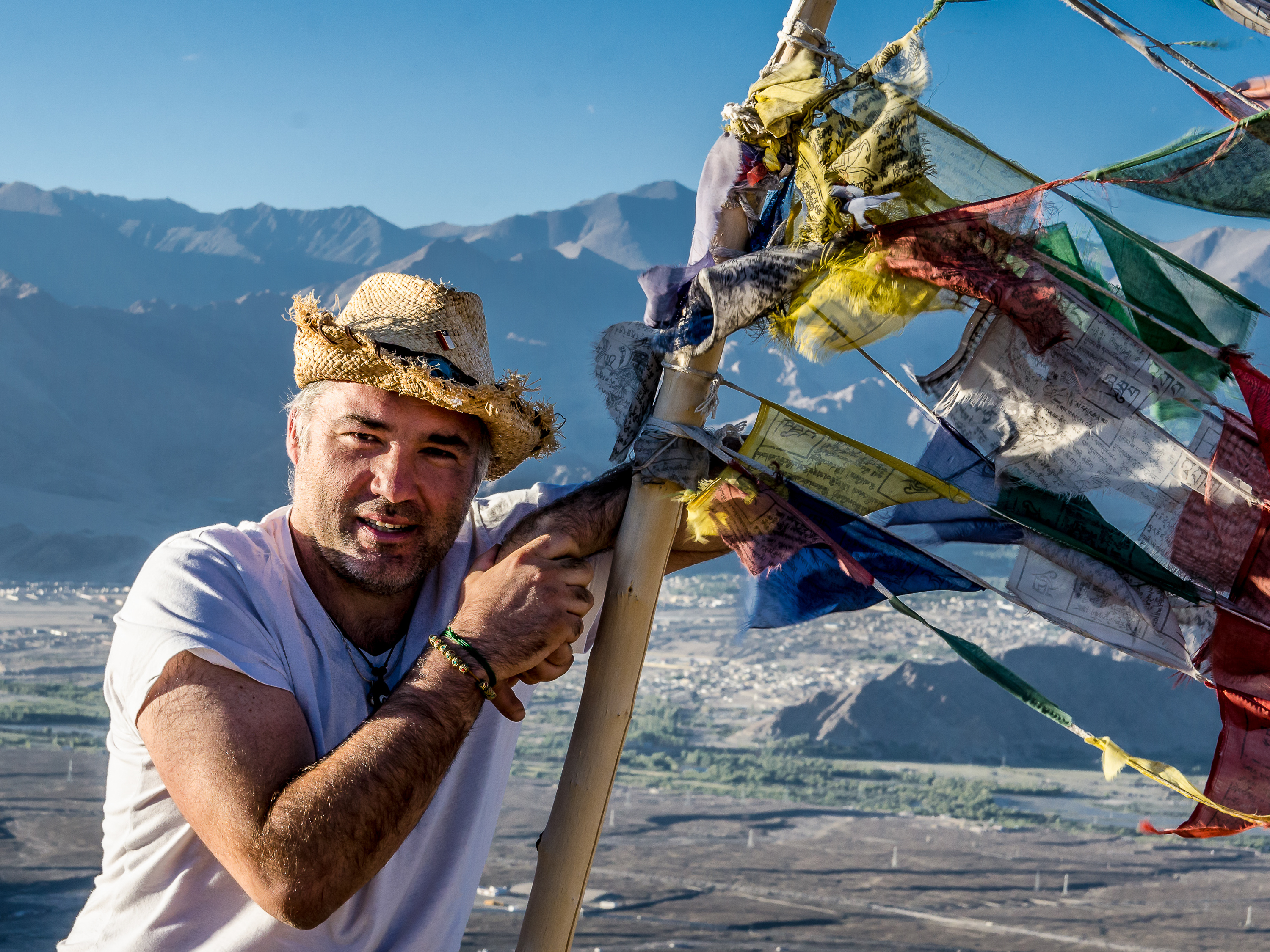
From Grado to Salas | Camino Primitivo
There are mornings when you wake up and immediately know that the day is going to be different.
It was still early when I opened my eyes in the albergue in Salas. Outside, the sky was grey and a fine drizzle was falling over the town, the kind of rain that is not quite enough to make you turn around and go back to bed, but is certainly enough to make you question whether the weather forecast really knows what it is talking about. According to the forecast, the day should eventually become warmer, with temperatures reaching around twenty-four degrees, so we decided to trust the forecast and the Camino rather than the clouds above our heads.
The albergue itself had been beautiful, but the night had been less successful.
There are certain things you simply cannot control when you sleep in a shared dormitory, and one of them is the person lying in the bed next to you. My neighbour had apparently decided that sleeping was an activity best accompanied by an impressive orchestral performance of snoring. At some point during the night, I gave up, took my bedding outside and made myself a temporary bed under an umbrella. It was surprisingly comfortable, and if the rain had not started around two in the morning, I might very well have stayed there until sunrise.
So that was my first adventure of the third day. Fortunately, breakfast was excellent.
And after breakfast, there was only one thing left to do.
Walk.

The third stage from Salas to Tineo is officially around 19.7 kilometres, making it considerably shorter than the previous day. Turismo Asturias describes the stage as a gradual ascent, particularly between Salas and Porciles, followed by a much more stable profile for the remainder of the route. The surface is a mixture of asphalt, dirt tracks and gravel, with the landscape gradually changing as the Camino crosses from the municipality of Salas into Tineo.
On paper, it looked like an easy day.
But I was beginning to understand that the Camino had its own definition of the word easy.
We left Salas and slowly entered the valley, walking between two hills while a thick morning fog covered the landscape. Everything looked soft and distant, as though somebody had deliberately turned down the contrast of the world.
The road rose gently beneath our feet.
Nothing dramatic.
Nothing particularly difficult.
Just enough of a climb to remind us that the day had begun.
And somewhere in that quiet landscape, we started walking through a history that was much older than the Camino itself.

Around Salas and further west towards Tineo, mining has been part of the story of the land for centuries.
The most famous mining heritage of the wider Tineo area is associated with gold. The local evidence shows that gold extraction did not necessarily begin with the Romans; there are indications that the indigenous Asturian communities were already familiar with metalworking and may have exploited local resources before Roman conquest. The Romans, however, transformed gold mining into something on a much larger scale.
Their methods were extraordinary.
One of them became known as ruina montium — literally, the destruction or collapse of the mountain. The Romans constructed elaborate systems of channels and reservoirs to bring enormous quantities of water to the mountainside, using the force of the water to break apart and wash away the rock in search of gold. The remains of this ancient engineering can still be seen in places such as Navelgas, Lavadoira and the Sierra del Ouro.

It is difficult to imagine while walking through the peaceful green landscape that two thousand years ago people were deliberately changing the shape of entire mountains.
But Asturias has another mining history too.
Much later, the mountains of western Asturias became important for coal and anthracite mining. Tineo developed a significant underground mining industry, and official records still document former anthracite operations such as the Pilotuergo complex, where extraction finally ceased in December 2018.
So while we were walking through misty fields and forests, the landscape beneath our feet was telling several different stories at once: indigenous mining, Roman gold, modern coal and the industrial transformation of Asturias.
The Camino has a strange way of doing that.
You think you are simply walking from one town to another, but the ground itself keeps reminding you that you are passing through thousands of years of human history.
After a few kilometres, another kind of history appeared above us. The new motorway.
The A-63, the Oviedo–La Espina motorway, has been one of the major infrastructure projects in this part of Asturias, intended to improve connections between Oviedo and the western part of the region. The project has developed in sections over many years, and the landscape around Salas and La Espina has been dramatically altered by bridges, viaducts, tunnels and new road corridors.
When we walked this stage, the contrast was particularly striking. The Camino was taking us through a landscape where people had travelled on foot for centuries, while enormous concrete structures carried modern traffic overhead.
Some sections of the A-63 had already opened, while other parts were still under construction or incomplete. The history of the motorway itself is almost a story of its own: delays, difficult terrain, major engineering works and changing plans have stretched the project over decades. The second carriageway between Salas and the El Regueirón viaduct entered service in November 2022, while the Salas–Cornellana section remained affected by major slope instability and delays. Even in 2026, Asturias was still pressing for the completion of that section and for progress on the future La Espina–Tineo connection.
Walking underneath one of these huge structures, I found myself thinking about the strange relationship between progress and permanence. The Romans once moved mountains to find gold. Today we move mountains to build roads. The tools have changed.
Perhaps we haven't changed quite as much as we like to think.

At around three kilometres, the route still felt gentle enough. We had gained some height, but nothing that seemed particularly alarming. Then the road became steeper. And steeper.
At around the fifth kilometre, I remember looking ahead and thinking that surely the climb must be coming to an end soon. The Camino has a wonderful sense of humour when you think that way.
Eventually, though, the gradient began to ease and we were able to settle into a more comfortable rhythm. The morning fog remained with us for a while, turning the surrounding fields into something almost dreamlike. There were no crowds, no traffic and very little noise, apart from birds and the occasional distant tractor.
It was exactly the kind of landscape in which walking becomes less about getting somewhere and more about simply being there.
Eventually, we reached Bodenaya, one of the small settlements along this stage. The church here is Santa María de Bodenaya, which stands beside the route and has welcomed pilgrims for generations. It is easy to walk past places like this when you are concentrating on kilometres.
That is one of the dangers of the Camino. You become obsessed with the destination.
How many kilometres have we done? How many are left? Where is the next café?
Where can we sit down? How long until the albergue?
And in the process, you can miss the very things that make the journey worthwhile.
A small church. An old stone wall. A tree that has probably been there longer than most of the houses. A farmer watching you walk past.
The Camino is full of such details, but you have to slow down enough to see them.

From Bodenaya, the route continues towards La Espina, one of the most important stopping points on this stage. Here the character of the landscape begins to change. The route has climbed substantially from Salas, and the high plateau gives the traveller a different perspective over the surrounding countryside.
La Espina has also always been more than just another village on the map. Its position made it an important crossroads, and historically it offered pilgrims accommodation and assistance. Turismo Asturias notes that there were two pilgrim aid establishments here, including one documented as early as 883, making it one of the oldest known establishments connected with the Jacobean world.
Today the practical importance is slightly different. For a modern pilgrim, La Espina is simply the place where you can finally get a coffee, withdraw money, buy food or take a proper break. And believe me, after several kilometres of climbing, these things suddenly become very important.
Somewhere along this day's walk, my thoughts began moving in a completely different direction.
I had previously written on Facebook that God does not exist, but life does. Some friends had responded that they hoped I would eventually find God because, in their view, God certainly exists.
And now, walking slowly through the Asturian countryside, I found myself thinking about that conversation again.
Maybe the question isn't whether God exists. Maybe the question is what we mean when we use the word God. For me, the idea of an external institution telling us exactly what God is, what God wants and how we are supposed to experience God has never felt completely convincing. Perhaps we look in the wrong direction.
Perhaps if there is something greater than ourselves, we should first look for it inside ourselves rather than somewhere outside. Because there are moments when you experience something beautiful and don't need anybody to explain it to you.
A landscape suddenly opening in front of you.
The sound of rain on an empty road.
The kindness of a stranger.
A piece of music.
A child's smile.
The feeling you get when you stand somewhere ancient and realise that thousands of people stood there before you. There are moments when something happens inside you that is difficult to describe. Maybe that is what some people call God. Maybe it isn't.I don't know.
And perhaps I don't need to know.
Later, we came across another small church in El Pedregal, the church of Santos Justo y Pastor.
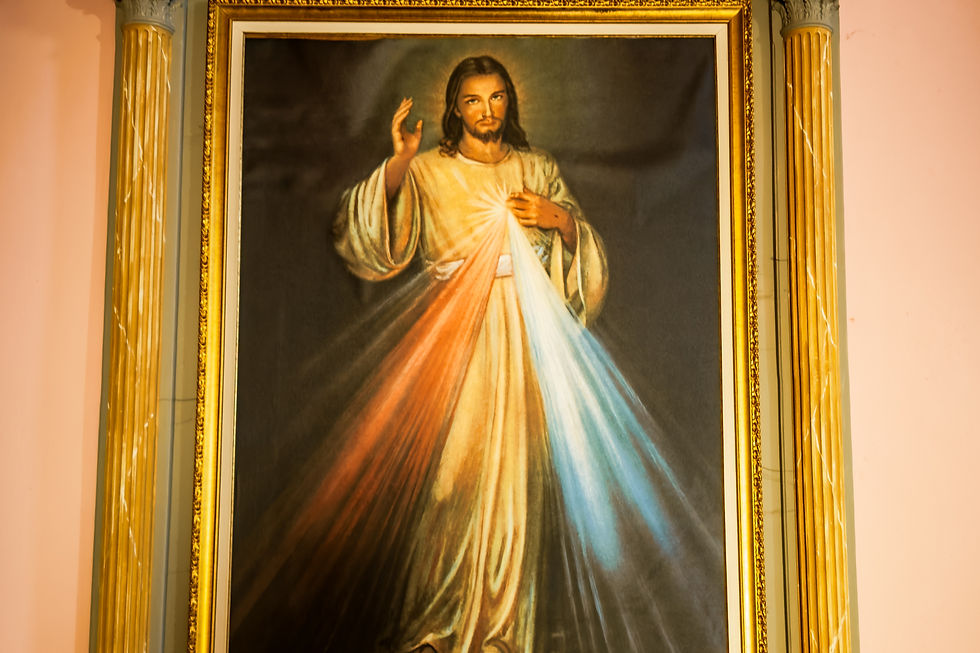
The building itself is simple, dating from the seventeenth century, and from the outside it doesn't appear particularly extraordinary. But inside, there was a painting of Christ that stopped me. I am not a particularly religious person, yet something about it affected me. It wasn't because suddenly I had found an answer. It was because the image created a feeling.
And perhaps that was exactly what I had been thinking about earlier. Maybe faith is not always about having answers. Maybe sometimes it is simply about recognising a feeling when it arrives.
Outside, the fog was finally beginning to disappear. The sun came through. And the landscape changed almost immediately. The same fields that had looked cold and mysterious in the morning became bright and green, the hills emerged from the mist and the Camino stretched ahead between farms and meadows. Sometimes the landscape doesn't change. Only the light does.
And yet everything looks different.
Along the route we also encountered one of Asturias' most remarkable living pieces of history: the Asturcón, the small, sturdy Asturian pony.
The breed has very ancient roots, and references to Asturian horses go back to antiquity. The Romans valued these animals for their endurance and other qualities, while their descendants later became associated with the so-called hobby horses of Britain and Ireland. During the twentieth century, the breed came close to disappearing, but breeding and conservation programmes helped preserve it.
Watching them standing quietly in the fields, it was difficult to imagine that these small horses had once travelled far beyond Asturias and were valued by people living hundreds or even thousands of kilometres away.
They looked completely at home here. After everything the landscape had seen — Romans, miners, pilgrims, farmers, engineers and travellers — these animals still belonged to it.

We finally reached Tineo in the early afternoon.
The official Camino route from Salas is only around 19.7 kilometres, and Turismo Asturias describes the first part as the demanding ascent towards Porciles and La Espina, followed by a much more stable route towards Tineo. For us, the final kilometres were beautiful.
Fields, forests, cattle and farms seemed to stretch endlessly across the hills, and the weather had finally given us the kind of day we had hoped for in the morning. We arrived early enough to have most of the afternoon ahead of us. And this time, we had made an important decision.
No shared dormitory.
After the previous night's concert of snoring, we decided that paying a little more for a private room was probably one of the best investments we could make. There would be no mysterious noises from the bed next door. No snoring. No unexpected midnight camping expedition.
Just peace.
Tineo has been an important settlement for much longer than the Camino has existed.
The municipality's historical material places the town within a landscape with prehistoric monuments, ancient mining activity and a long connection with the Asturian peoples. The first documentary reference to Tineo is traditionally dated to 895, while its importance on the Camino became especially significant in the Middle Ages.
The decisive moment came in 1222, when King Alfonso IX ordered pilgrims travelling towards Santiago to pass through Tineo and the monastery of Santa María la Real de Obona. This transformed Tineo into a strategic point on the Camino Primitivo and reinforced its role as the centre of a large medieval territory known as the Asturias de Tineo.
There was also a pilgrim hospital in Tineo dedicated to Nuestra Señora de Mater Christi, documented from the thirteenth century and remaining in operation until the nineteenth century. So when you arrive in Tineo as a modern pilgrim, you aren't simply arriving at the end of another stage. You are entering a town whose identity was partly shaped by people doing exactly what you are doing now.
Walking. Stopping. Eating. Sleeping. Continuing.
For hundreds of years.
One of the things that surprised me about Tineo was its relationship with Bolos de Tineo, the local form of bowling. The municipal history records references to the game as far back as 1070, although the sport itself is considerably older in its broader European context. Local legend says that when the Moors were fleeing Asturias, they left behind bowling pins and golden balls — a charming story, even if it belongs more to folklore than documented history.
What is not folklore is the importance the game acquired in everyday life.
Bowling alleys were traditionally located close to churches, allowing people to play after Mass. The sport became woven into village life, social gatherings and local identity.
And the Tineo version is quite spectacular. The game uses a large number of pins, and the playing area itself is considerably more substantial than what most of us imagine when we hear the word bowling.
It is not simply a game.
It is a piece of local culture.
And it says something important about places like Tineo: traditions survive when they are not treated as museum exhibits but remain part of ordinary life.

Tineo's connection with food and celebration becomes particularly visible during the annual Fiestas de San Roque, the town's most important festivities.
The celebrations have their roots in the fourteenth-century Chapel of San Roque, where pilgrims travelling towards Santiago traditionally honoured the saint. By the nineteenth century, the festival had also become associated with livestock markets and local produce, with people gathering around the chapel to trade animals and sell food.
Today, one of the most important days is 15 August — Día del Bollo.
The tradition centres around the distribution of bollo preñao, a piece of bread filled with chorizo, traditionally accompanied by wine, and the whole occasion has become a great communal gathering. The festival was officially declared a Regional Tourist Interest celebration in 1990. The modern festivities also include the Tineo bowling championship, which still takes place at the Campo de San Roque.
It is another example of how the Camino and everyday life have become intertwined in Tineo.
Pilgrims came here centuries ago. People celebrated here. They ate together. They played games. They traded livestock. They told stories.
And somehow, pieces of that world have survived.

We eventually entered the Church of San Pedro, and inside we discovered something I had not expected: the Museum of Sacred Art of Tineo.
The museum contains an extensive collection of religious sculptures and objects from churches and chapels throughout the municipality, including wooden works from the Middle Ages, Renaissance and Baroque periods. The collection also contains goldsmith work, liturgical clothing, sacred ornaments and an important library, including editions dating back to 1522.
Among the most remarkable objects are medieval sculptures and a Romanesque Calvary, together with images of Christ and the Virgin. Some of the faces were centuries old, yet they still seemed capable of producing an emotional response in somebody standing in front of them today.
One small statue reminded us strongly of the famous Infant Jesus of Prague, and the local priest confirmed that the resemblance was not simply our imagination.
And then there were the doors. Beautifully made, worn by time and use, they seemed almost as interesting as what was behind them. It was one of those places where you realise that art does not necessarily have to be enormous or famous to matter.
Sometimes it survives simply because somebody cared enough to preserve it.

After nearly twenty kilometres of walking and an afternoon of exploring the town, there was really only one appropriate thing left to do.
Eat.
We stopped at a local bar and ordered something simple — cheese and asparagus toast — but the real discovery was something much more local. Chosco de Tineo.
This is not simply another Asturian sausage. It has protected PGI status — Protected Geographical Indication — at European level, and its production is deeply connected with the history and environment of Tineo and the surrounding area.
Traditional Chosco de Tineo is made from selected cuts of pork loin and tongue, seasoned with salt, paprika and garlic, placed into a pig's intestine, smoked and then cured. Unlike minced sausages, the individual pieces of meat remain visible when the chosco is sliced.
Its history is closely connected with the rural economy of western Asturias. Pigs were traditionally kept by households because they were perfectly suited to a largely self-sufficient agricultural system. They could make use of food waste, agricultural by-products, chestnuts, acorns and other resources that were abundant in the countryside. And then there was the climate.
This part of Asturias is wet, mountainous and often isolated during winter. Smoking became an effective way of preserving meat for longer periods. Traditional production used local wood for smoking, followed by drying in well-ventilated spaces such as hórreos.
The connection between chosco and Tineo is not a recent marketing invention either. Historical sources mention it as a characteristic food of the San Roque celebrations as far back as the early twentieth century, while nineteenth-century sources already describe the importance of pig breeding and meat production in the region.
After a day on the Camino, however, all of that history becomes pleasantly simple.
You sit down. Someone puts food in front of you.
You take the first bite. And you realise that sometimes the best way to understand a place is through your stomach.

By the time evening arrived, the day had somehow become much bigger than the twenty kilometres we had walked.
We had climbed out of Salas through the mist, passed through forests and fields, walked beneath enormous modern infrastructure, followed traces of ancient mining, visited churches, met animals that carry the genetic memory of ancient Asturias, explored Tineo and tasted a food whose history is inseparable from the people who have lived here for generations.
But somewhere between all those things, something else had been happening.
I had been thinking.
About God.
About silence.
About what happens when the Camino ends.
About returning home.
About turning the notifications back on.
About emails waiting for answers.
About the strange speed at which modern life moves.
And I realised that perhaps I didn't want to go back exactly the same person who had left.
I knew that I couldn't stay on the Camino forever.
Eventually there would be responsibilities again.
The Camino had already begun teaching me that silence isn't emptiness. Sometimes silence is where you finally hear yourself. And perhaps God, if there is such a thing, doesn't necessarily live in a church, a book or an institution.
But on this particular day, I had stopped being quite so interested in finding an answer.
Maybe the question itself was enough.
Stage 3 — Salas to Tineo
Distance: approximately 19.7 km on the official route
Walking time: around 5–7 hours depending on pace and stops
Route: Salas → Porciles → Bodenaya → La Espina → La Pereda → El Pedregal → Santa Eulalia → Zarracín → TineoTerrain: asphalt, dirt paths and gravel tracks
Character: gradual and more demanding ascent at the beginning, followed by a more stable and gently undulating route towards Tineo.
Places worth noticing
Bodenaya — Santa María de Bodenaya and the traditional Camino landscape.
La Espina — an important historic stopping point with a long pilgrim tradition.
La Pereda — entrance into the municipality of Tineo and the Ermita del Santo Cristo de los Afligidos.
El Pedregal — the church of Santos Justo y Pastor and historic pilgrim connections.
Tineo — historic Camino town, Church of San Pedro, Museum of Sacred Art, Palacio de Merás, Campo and Chapel of San Roque.
PS: At the end of the series I will publish a guide book with all camino information :) Stay tune.
Ps: If you enjoy the reading and would like to support me, you can buy me a coffee :)

English video on Youtube: (thank you of you subscribe to get notified) New episode every Sunday at 5:00 PM CET


Comments