
Day 6. Camino Primitivo | How long can we fall?
Updated: Sep 22
From Berducedo do Grandas de Salime | Camino Primitivo | How long can we fall?
There are days on the Camino when the distance itself is not particularly intimidating, yet the landscape, the weather, the elevation changes and everything that happens along the way somehow manage to make the journey feel much larger than the number of kilometres written on the map.
Stage 6 of the Camino Primitivo was one of those days, a seventeen-kilometre journey from Berducedo towards Grandas de Salime that began high above the valleys, carried us through a landscape slowly emerging from the morning mist, and eventually led us down towards one of the most striking and unexpected places on this part of the Camino: the enormous Salime reservoir.
After almost a week of walking through Asturias, we had already experienced a little of everything the Camino could offer us. We had climbed mountains, crossed quiet valleys and walked through rain, sunshine and thick fog, while our bodies had gradually begun to understand the particular rhythm of long-distance walking. There were moments when our legs felt heavy, when hunger seemed to arrive at exactly the wrong time, and when the next hill appeared considerably more demanding than it had looked from a distance, but there had also been countless moments of beauty and unexpected encounters that made all the tiredness worthwhile.
One of those encounters happened towards the end of the previous day, when we met another couple who were walking the Camino with an enthusiasm that was impossible to miss. They were tired, they had already discovered that the Primitivo was considerably more demanding than perhaps they had imagined before arriving in Asturias, and yet they remained genuinely excited about everything around them. They wanted to talk about the road, the landscape, the experience and the stages still waiting ahead, and when we began explaining what was coming, including the climbs, the backpacks and the importance of starting early, they listened with an almost infectious curiosity.
There was something wonderfully refreshing about watching people who were still at that stage of the journey when every new day felt like an adventure rather than another physical challenge to overcome. After several days on the Camino, it becomes surprisingly easy to become obsessed with your own tired feet, the weight of your backpack and the next climb waiting somewhere beyond the horizon, and in doing so you can gradually lose sight of the reason you started walking in the first place.
The Camino is demanding, but it is also full of curiosity, discovery and those small moments when an ordinary landscape suddenly becomes something memorable. Perhaps we sometimes need other people to remind us of that.
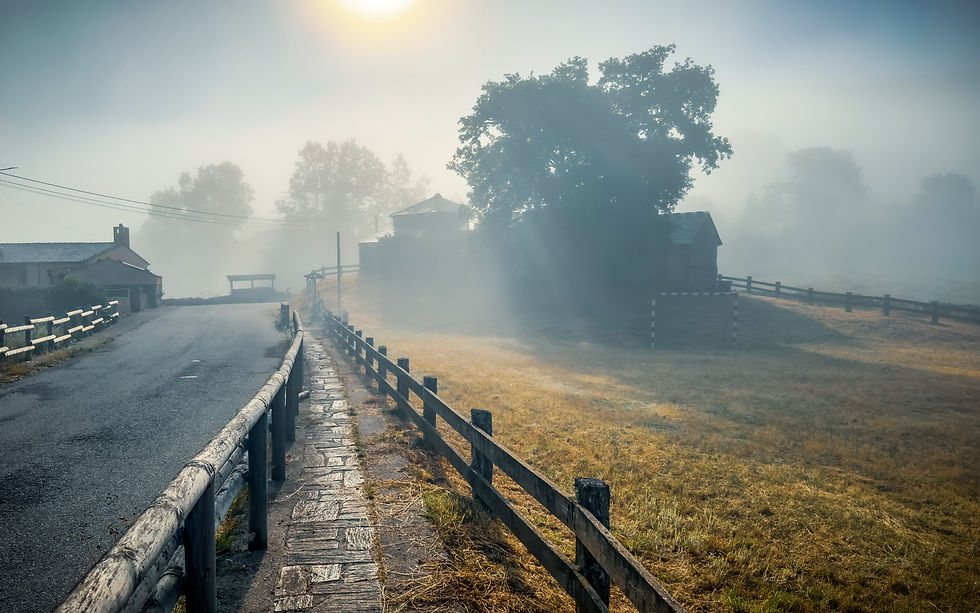
Leaving Berducedo, the route initially continued through the high landscape that had already become familiar during the previous stages, with open countryside, meadows and wide views across the surrounding mountains. The morning still carried traces of the fog that had settled over the valleys, and for a while the world below us remained hidden beneath a soft layer of cloud, creating that strange sensation we had already experienced earlier on the Camino, when it felt as though we were walking somewhere above the ordinary world.

There is something particularly beautiful about seeing fog from above rather than walking through it, because the landscape becomes divided into two completely different worlds: the solid ground beneath your feet and the mysterious white expanse stretching below you, concealing everything that lies beyond it. The mountains appear to rise from the clouds, and for a short time the Camino seems almost detached from the world below.
Eventually, however, the fog began to dissolve, the sunlight started finding its way through the landscape, and the scenery gradually opened again.
Our route continued towards Buspol, a tiny settlement that might be easy to overlook if you were simply passing through without knowing anything about its history, yet this isolated place has an important connection with the medieval Camino. Buspol once had a pilgrim hospital, providing shelter for people travelling through this remote section of Asturias at a time when the journey was considerably more dangerous and demanding than it is today.
Nearby stands the small Chapel of Santa Marina, a simple stone building that seems almost inseparable from the landscape around it. The chapel is traditionally dated to the fourteenth century, while its bell bears the date 1327, giving this otherwise quiet corner of the mountains a tangible connection with the pilgrims who passed through here centuries ago.
Standing beside such a small building in such an enormous landscape makes you realise how different the Camino must once have been. There are no large settlements here, no busy roads and very little evidence of modern life, and yet for centuries people have been walking through these mountains on their way towards Santiago.
The landscape has changed, the people have changed and the reasons for travelling have changed, but the road itself has remained.

Leaving Buspol, the Camino led us through open meadows, and once again the journey provided one of those small adventures that you never really plan for.
A gate stood across the route, meaning that the only way forward was to open it and continue through the fields, where the real inhabitants of the landscape were already waiting for us. Cows were scattered across the meadows, watching the passing pilgrims with considerably more interest than we perhaps expected.
We had been warned that cattle can sometimes be unpredictable, particularly when people get too close, so there was no reason to take unnecessary chances, but these particular animals appeared much more interested in their afternoon than in the pilgrims crossing their territory. The fog was disappearing, the sun was becoming stronger and the entire landscape was slowly changing character, transforming what had initially been a grey and mysterious morning into a warm mountain afternoon.
And then the direction of the Camino changed.
The path began to fall.
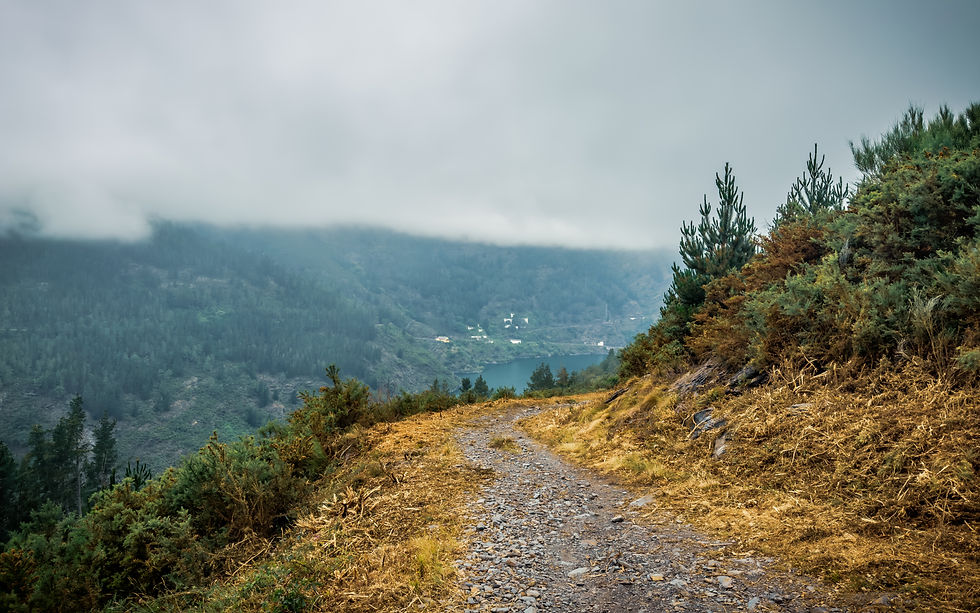
At first, descending always feels like a reward after climbing. Your breathing becomes easier, your body relaxes and the thought of losing elevation instead of gaining it feels almost luxurious. But the further you descend, the more you begin to understand that downhill walking has its own demands, particularly when the descent continues for kilometres and the gradient becomes increasingly steep.
The Camino was now taking us towards the Navia valley and the Salime reservoir far below.
From above, the water appeared almost impossibly distant, a greenish-blue line between the mountains, and with every turn of the trail it became larger and more visible. The descent seemed endless, and gradually your knees and feet begin to remind you that gravity is not always your friend.
Going down is not necessarily easier than going up.
Sometimes it simply hurts in a different way.
The temptation is to hurry because the destination is physically below you, but there is little point in racing down a mountain when the same legs will eventually have to carry you back up again. The Camino does not reward speed. It rewards endurance, patience and the ability to accept the rhythm of the road.
So we continued slowly, allowing the landscape to unfold around us, knowing that somewhere far below, the Salime reservoir was waiting.

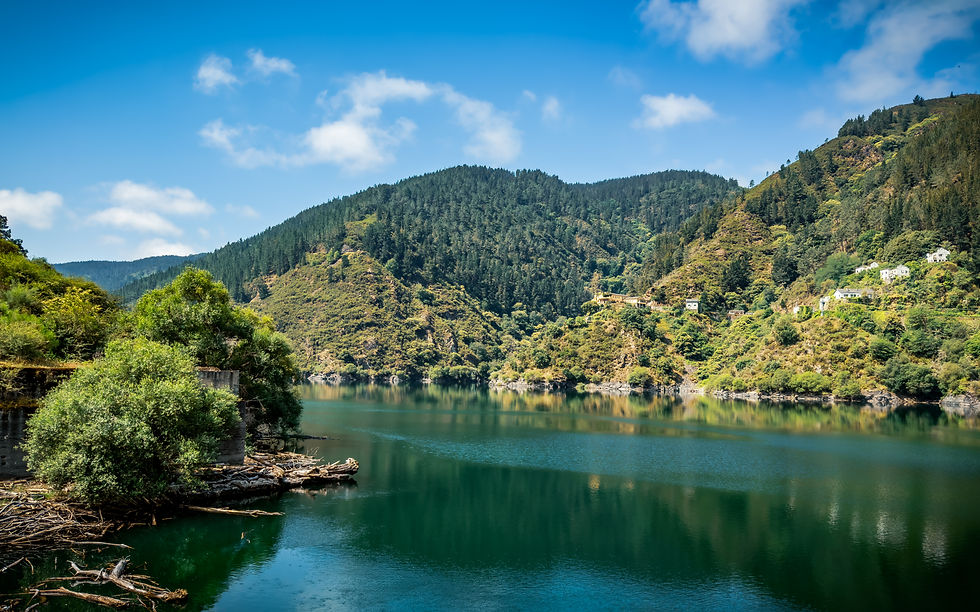
Eventually, after what felt like a very long descent, the reservoir began to dominate the landscape.
The water looked almost unreal against the mountains, especially after spending so much time walking through high country, and there was something deeply satisfying about finally reaching the place that had appeared impossibly far away from the trail above. Yet the closer we came, the more complicated the story of this landscape became.
The Salime reservoir is not simply a beautiful natural feature of Asturias. It is the result of one of the largest engineering projects ever undertaken in this remote part of Spain. The hydroelectric complex was constructed between the mid-1940s and 1955, transforming the valley and creating a huge artificial lake whose water would eventually become an important source of hydroelectric power.
The first generating unit began producing electricity in December 1953, followed by the remaining units during the following two years. But every great engineering project has its price, and here the price was an entire landscape.
Around 685 hectares of land were flooded to create the reservoir. Fields, roads, bridges, churches, chapels and parts of several settlements disappeared beneath the rising water, while the old village of Salime, which gave the reservoir its name, was submerged.
It is a strange experience to stand beside the water and realise that what you are looking at is also a kind of landscape of absence.
Beneath the surface there was once another world. There were houses, fields, roads. There were people living their ordinary lives.
Today, none of that can be seen, and yet knowing that it is there gives the reservoir a completely different character. The landscape is undeniably beautiful, but there is also something haunting about it, because its beauty exists partly because another landscape was sacrificed to create it.

As we continued towards the dam, traces of the enormous construction project began to appear around us.
The scale of the undertaking becomes difficult to understand from photographs alone. This was not simply a matter of building a wall across a river and allowing water to collect behind it. The project required roads, workshops, storage areas, concrete production facilities, transportation systems and accommodation for thousands of workers who had to live and work in this remote mountain valley.
One of the most remarkable elements of the construction was a cableway stretching for approximately thirty-six kilometres, which was used to transport materials from the coast towards the construction site. Thousands of workers were involved in the project, with more than 3,500 people brought into the area during the construction period.
Entire communities appeared around the project to accommodate them.
For a landscape that today can feel almost empty, it is extraordinary to imagine the noise and movement that must once have filled these mountains: machinery operating, materials being transported, workers moving between construction sites, roads being built and concrete being poured on an enormous scale. Much of that world has now disappeared.
Vegetation has gradually reclaimed many of the old construction areas, while walls, ruins and fragments of infrastructure remain scattered through the landscape like pieces of a forgotten industrial civilisation.
Walking past them, you might initially see nothing more than an old wall or a few stones, but when you understand what they represent, they become something much more significant.
They are reminders of the people who came here to build something that would permanently transform the valley. And then, eventually, the dam itself comes into view.

There is a moment when the scale of the Salime project finally becomes impossible to ignore.
The mountains rise steeply on both sides of the valley, while the reservoir stretches away into the distance, following the shape of the landscape that existed long before the dam was built. Between them stands the enormous concrete structure that changed everything.
The Salime dam rises approximately 130 metres above the valley, and when it was completed it was considered one of the largest dams in Europe. Standing there, looking at the reservoir from above, it becomes difficult to imagine the amount of work that went into creating it. Thousands of workers. Years of construction. Huge quantities of concrete and other materials. Entire settlements created for the workforce. Roads and transport systems built into the mountains. And beneath the water, an older landscape permanently transformed.
The dam is an impressive piece of engineering, but perhaps what makes it most fascinating is the contrast between human ambition and the enormous natural landscape surrounding it. The mountains remain, the river continues to flow and the seasons continue to change, yet the valley itself has been permanently reshaped by something humans built here more than seventy years ago.
After so much descent, reaching the reservoir almost feels like the end of the day. But the Camino has a habit of refusing to finish when you think it should. There was still one final challenge waiting for us: the climb towards Grandas de Salime.
After spending so many kilometres going downhill, it felt almost strange to turn upwards again, but perhaps that is exactly what makes the Camino so honest. Just when you think you have finally reached the end of the difficult part, the road reminds you that the journey is not finished yet. You think you have reached the end, and then another hill appears.
And that is one of the reasons the Camino stays with people long after they have returned home. It constantly refuses to behave exactly as expected, and because of that, it keeps forcing you to pay attention.
This day had begun high above the clouds, surrounded by mist and mountain meadows. We had walked through fields occupied by curious cows, passed a medieval pilgrim settlement and a centuries-old chapel, descended through the mountains towards the water, discovered the hidden history beneath the Salime reservoir and stood above a dam that had transformed an entire valley.
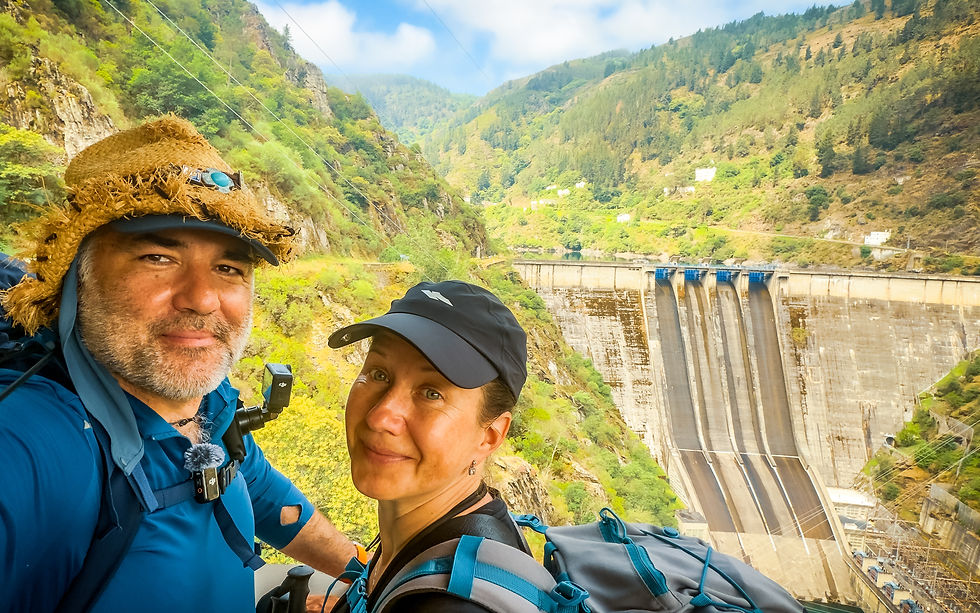
All of that had happened within a single day's walk. And that is perhaps the real measure of the Camino. It is not simply the number of kilometres written beside a stage on a map.
It is everything that happens between one place and the next.
Sometimes the important thing is history, suddenly becoming visible in a ruined wall or an old chapel. Sometimes it is nature, appearing in the form of mountains, fog, sunlight or water. Sometimes it is another person you meet for only a few minutes but remember for years.
And sometimes it is simply the view in front of you, arriving at exactly the right moment and giving you a reason to stop walking for a while.
By the time we reached Grandas de Salime, our legs were tired and the day's descent and final climb had made sure we had earned the rest waiting for us. But there was also that familiar feeling that appears at the end of a Camino stage: the quiet satisfaction of knowing that the road had once again taken us somewhere we could not have reached without walking every kilometre between the beginning and the end.
Grandas de Salime was waiting.
And once again, we kept walking.
Because tomorrow would bring something completely new.
Galicia.
See you next time.
Vashek

The route at a glance:
Stage: Berducedo → Buspol → Salime Reservoir → Grandas de Salime
Distance: Approximately 19.5 km walked
Difficulty: Moderate, with the main physical challenge being the long and steep descent towards the Salime Reservoir
Highest point: The route begins in the high mountain landscape around Berducedo before descending towards the Navia valley
Main descent: Approximately 5–7 km of sustained downhill walking towards the Salime Reservoir
Final climb: After reaching the reservoir, the route climbs again for approximately 5–6 km towards Grandas de Salime
Surface: A mixture of mountain paths, dirt tracks, meadows and roads, with a particularly demanding downhill section before reaching the reservoir
Main places: Berducedo → Buspol → Salime Reservoir → Grandas de Salime
Important landmarks: Buspol, Chapel of Santa Marina, Salime Reservoir, Salime Dam and the surrounding hydroelectric infrastructure
Historical character: Buspol was once home to a pilgrim hospital, while the Chapel of Santa Marina preserves a connection with the medieval Camino. The Salime valley was dramatically transformed by the construction of the hydroelectric complex in the mid-20th century, which flooded approximately 685 hectares of land and submerged the old village of Salime.
Best-known feature of the stage: The dramatic descent from the mountains to the Salime Reservoir, followed by the final climb towards Grandas de Salime.
Practical consideration: Although the stage is relatively short, the sustained descent can be demanding on the knees and feet, particularly after several consecutive days of walking, so allowing plenty of time and maintaining a controlled pace is advisable.
PS: At the end of the series I will publish a guide book with all camino information :) Stay tune.
Ps: If you enjoy the reading and would like to support me, you can buy me a coffee :)

English video on Youtube: (thank you of you subscribe to get notified) New episode every Sunday at 5:00 PM CET

Comments