
Day 7. Camino Primitivo | What is the price for miracles?
From Grandas de Salime to Padron | Camino Primitivo | What is the price for miracles?

The seventh stage of the Camino Primitivo began with a feeling that something was about to change. After several days of walking through Asturias, through its mountains, forests, remote villages and long stretches of quiet countryside, we were finally approaching the border with Galicia. The day ahead was supposed to be around twenty-seven kilometres, although, as it turned out, the Camino had other plans for us, and by the time we finally reached our accommodation we had walked more than twenty-eight.
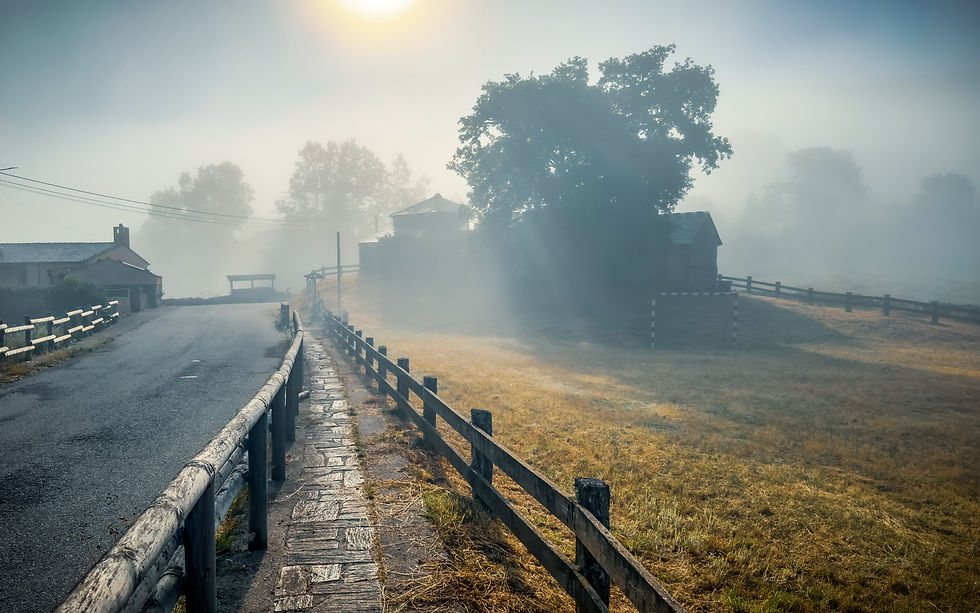
We knew from the beginning that this would be a long day, and that somewhere around the middle of it a serious climb was waiting for us. That was precisely why we had decided to leave early, shortly after seven in the morning, hoping to complete the hardest part before the heat became too intense. The morning was pleasantly warm and slightly cloudy, with a little fog hanging over the landscape, and after several days of walking we had learned that there was little point in fighting the Camino or trying to force the day to move faster than it wanted to.
Sometimes the best strategy is simply to start walking and see what happens.

Grandas de Salime was still quiet when we left. Before disappearing into the countryside, we passed the Collegiate Church of San Salvador, one of the most important historical buildings in the town and a place with a long connection to the pilgrimage route.
The origins of the church go back to the twelfth century, although the building was altered and expanded over the centuries, leaving behind a mixture of architectural influences. Its covered arcade was particularly important for pilgrims in the past, providing somewhere to shelter and rest before continuing along the difficult route towards Galicia.
There was something appropriate about beginning this particular stage beside a building that had watched generations of pilgrims come and go, because this was going to be a day of transition. We were not simply walking from one town to another; we were leaving one region behind and entering another, and with it, the final part of our journey towards Santiago was beginning to feel much more real.

Once we left Grandas de Salime, the Camino quickly returned to the landscape that had accompanied us throughout Asturias: narrow lanes, green meadows, stone houses, forest paths and small chapels appearing unexpectedly beside the road.
After several days, you might expect such scenery to become familiar enough to lose its magic, but that never really happened. The landscape could look similar from one morning to the next, yet the light was never the same, the clouds were never in the same place, and the combination of fog, sunlight, forest and distant mountains constantly changed the character of the road.
That is one of the quiet lessons of walking: even when the landscape appears unchanged, you are not.
As the kilometres passed, we moved through small settlements and countryside where life still seemed closely connected to the land. Meadows, livestock, stone walls and old buildings surrounded the Camino, while the road gradually began to lead us higher.
One of the important places along this section was Peñafonte, where the Church of Santa María Magdalena provided one of the last significant stops before the route left Asturias.
The church dates from the seventeenth or eighteenth century, but for pilgrims, the spring beside it has traditionally been just as important as the building itself. Water becomes a surprisingly important subject on the Camino, particularly on hot days, and knowing where you can refill your bottle can make a significant difference when a long climb is waiting ahead.
By around seven kilometres into the day, the walking had still been relatively comfortable. The route was largely gentle, passing through forest and open countryside, and a light fog continued to soften the landscape around us.
But we knew what was coming. The climb towards the Alto del Acebo was waiting.

For the first part of the morning, the Camino had allowed us to settle into an easy rhythm, but eventually the road began to rise more seriously.
The climb towards Alto del Acebo is not simply another small hill along the route. It is the defining physical challenge of the day, and after several hours of walking, the increasing gradient begins to demand considerably more from your legs.
The higher we climbed, the more the landscape opened around us, and the fog that had initially seemed to hide the mountains began to create something completely different. Instead of simply blocking the view, it became part of it, filling the valleys below while the higher ground remained illuminated above the clouds.
There are moments on the Camino when the physical effort becomes almost secondary because the landscape becomes so overwhelming that you stop thinking about how tired you are.
This was one of those moments. The climb eventually brought us to approximately 1,116 metres above sea level, the highest point of our day, and suddenly the meaning of the climb became much greater than simply reaching the top of a hill. We were standing on the border between Asturias and Galicia.
For several days, Asturias had been our world. We had crossed its mountains, walked through its forests and villages, eaten its food and followed a route that had been carrying pilgrims towards Santiago for centuries. Now, after only a few steps, that chapter was ending.

There was no dramatic wall, no gate and no great geographical divide announcing the border. There was simply a marker.
A few steps.
And suddenly we were in Galicia.
The landscape itself did not immediately change. The green hills continued, the forests continued, and the Camino continued almost exactly as it had before. Yet psychologically, something had shifted.
The Camino markers now began showing the distance to Santiago de Compostela, and when we passed the marker indicating approximately 166 kilometres remaining, the significance of the moment became even stronger. We were roughly halfway through our pilgrimage.
For the first time, Santiago no longer felt like an abstract destination somewhere far away at the end of the road. It had become a number written on a stone marker. One hundred and sixty-six kilometres. Still a long way. But suddenly much closer. There were around twenty pilgrims gathering at the border, many of whom we had already encountered during the previous days. That is another strange characteristic of the Camino: people constantly disappear and reappear.
You might meet someone at breakfast, then lose them somewhere on the trail, only to discover them again hours later at a café, a fountain or a mountain pass. Slowly, without making any conscious decision to do so, a collection of strangers begins to become a small Camino family.

At the border, everyone seemed to feel the significance of the moment in their own way.
We had arrived together. We had crossed together. And for a few minutes, the Camino felt less like a solitary journey and more like something we were all experiencing collectively.
I had imagined that entering Galicia would feel completely different, but in reality the transition was surprisingly subtle. The landscape remained green, the forests continued and the small villages still appeared along the road. Yet there was a slightly different character to the countryside, and the Camino itself gradually began to feel more open. Perhaps the greatest difference, however, was not geographical at all. It was psychological.
For several days, Asturias had been our home. Now we could finally say that we had crossed the border, entered Galicia and were moving into the final part of the journey towards Santiago. And because we had just climbed to the highest point of the day, I made a mistake that the Camino would soon correct. I assumed the hardest part was behind us.
I thought we had climbed the mountain, crossed the border and could now expect a relatively easy combination of downhill and flat walking. The Camino, as it often does, had other ideas.

By the time we reached approximately twenty kilometres, we had found a restaurant and bar beside the road, which seemed like the perfect opportunity to stop for a while. It was around quarter to one, we still had roughly seven kilometres ahead of us, and there was no reason to rush. We had already completed the major climb, so we took off our shoes, found some shade, had something cold to drink and allowed ourselves to relax for a while.
After several days of walking, the stage actually felt easier than expected. We were simply becoming more experienced pilgrims. The hills that had seemed intimidating at the beginning of the Camino were no longer quite as frightening, and our bodies were slowly learning how to deal with long distances, changing terrain and the inevitable fatigue that arrives after hours on the trail.
From there, the route continued through forest, fields and stretches alongside the road, with a gentle rise here and a descent there. It felt almost comfortable. And then we saw Fonsagrada.
Seeing your destination is one of the great psychological tricks of the Camino.
You look ahead and think, There it is. We are almost there.
But seeing a place and actually reaching it are two completely different things. We could see Fonsagrada in the distance, and for a moment it felt as though the day was essentially finished. It wasn't. The final approach included another climb, and the last 800 metres uphill into Fonsagrada turned out to be one of the hardest parts of the entire day.
By then, we had already walked more than twenty-five kilometres, the heat was becoming increasingly intense and the body was running low on energy. There is something particularly frustrating about a final climb because your mind has already started celebrating the finish while your legs are still being asked to work.
You know you are close.
You can see where you are going.
And yet every metre seems to take longer than the one before it. I was running on empty, but there was still something inside me that refused to stop. Perhaps it was pride, perhaps stubbornness, or perhaps simply the accumulated determination that develops after several days on the Camino. Whatever it was, it carried me upwards. And once again, the reward was waiting at the top.
The view.

It seems to happen repeatedly on the Camino: whenever a climb becomes so difficult that you begin to wonder why you are doing it, you eventually reach somewhere that makes you understand. The suffering does not disappear. But the perspective changes.
Fonsagrada has a long connection with the Camino Primitivo, and even its name reflects that history. It is generally associated with the Latin Fontem Sagrada, meaning sacred spring, a name connected with the fountain that has long been associated with the town and its pilgrims.
For centuries, its position between Asturias and Galicia made it an important stopping point for people travelling towards Santiago. Pilgrims needed places where they could rest, find food and receive assistance, and the surrounding area developed a network of hospitals and places of refuge.
One of the best known was the Royal Hospital of Santiago de Montouto, founded in the fourteenth century specifically to assist pilgrims travelling towards Santiago.
Walking through Fonsagrada after such a long day, the history feels particularly relevant. The modern pilgrim may arrive with technical clothing, a lightweight backpack, a smartphone and a booking confirmation, but the basic need remains unchanged.
You need somewhere to sit.
You need something to eat.
You need water.
And eventually, you need somewhere to sleep.
We stopped to restock our supplies, find something cold to drink and take care of the usual pilgrim essentials, including a visit to the pharmacy for some muscle ointment.
Fonsagrada had everything we needed: shops, an ATM, places to eat and drink, accommodation and pharmacies, making it an important practical stop on this section of the Camino.
But we were not finished yet. Our accommodation was still farther along the road.

By this point, the original plan for the day had already disappeared. What had started as a twenty-seven-kilometre stage had become a journey of more than twenty-eight kilometres, and although the final kilometres were not necessarily the most physically demanding, they felt long simply because the body had already spent so many hours walking.
There is a particular kind of tiredness that arrives late in the afternoon on a long Camino day.
After more than twenty-eight kilometres, it felt like a reward. The building itself was particularly beautiful, an old stone house that had once been little more than a ruin before being carefully restored. There was a small church beside it, a magnificent view across the valley and, most importantly, silence.
Absolute silence.
See you next time
Vashek

The route at a glance:
Stage: Grandas de Salime → Alto del Acebo → Fonsagrada → Padron
Planned distance: Approximately 27 km
Distance actually walked: More than 28 km
Difficulty: Long and demanding, with the main challenge being the climb towards Alto del Acebo and the unexpected final climb into Fonsagrada
Highest point: Alto del Acebo, approximately 1,116 m
Main climb: The significant ascent towards Alto del Acebo begins after Peñafonte, with the route reaching its highest point at around kilometre 12.5
Final climb: Approximately 800 m uphill into Fonsagrada, particularly demanding after more than 25 km of walking
Surface: A mixture of forest paths, rural lanes, roads, meadows and agricultural countryside
Main places: Grandas de Salime → Peñafonte → Alto del Acebo → Galicia → Fonsagrada → Padron
Important landmarks: Collegiate Church of San Salvador, Church of Santa María Magdalena in Peñafonte, Alto del Acebo, the Asturias–Galicia border and Fonsagrada
Historical character: Grandas de Salime and Fonsagrada have long been connected with the Camino Primitivo, while pilgrim hospitals such as the Royal Hospital of Santiago de Montouto provided shelter and assistance to medieval travellers
Water and supplies: There are limited opportunities to refill water during parts of the stage, particularly around the major climb, so carrying sufficient water is important
Major milestone: Crossing from Asturias into Galicia and passing the 166 km marker to Santiago de Compostela, approximately halfway through the pilgrimage.
PS: At the end of the series I will publish a guide book with all camino information :) Stay tune.
Ps: If you enjoy the reading and would like to support me, you can buy me a coffee :)

English video on Youtube: (thank you of you subscribe to get notified) New episode every Sunday at 5:00 PM CET


Comments