
Day 5. Camino Primitivo Pola de Allande Berducedo | Who is the boss here?
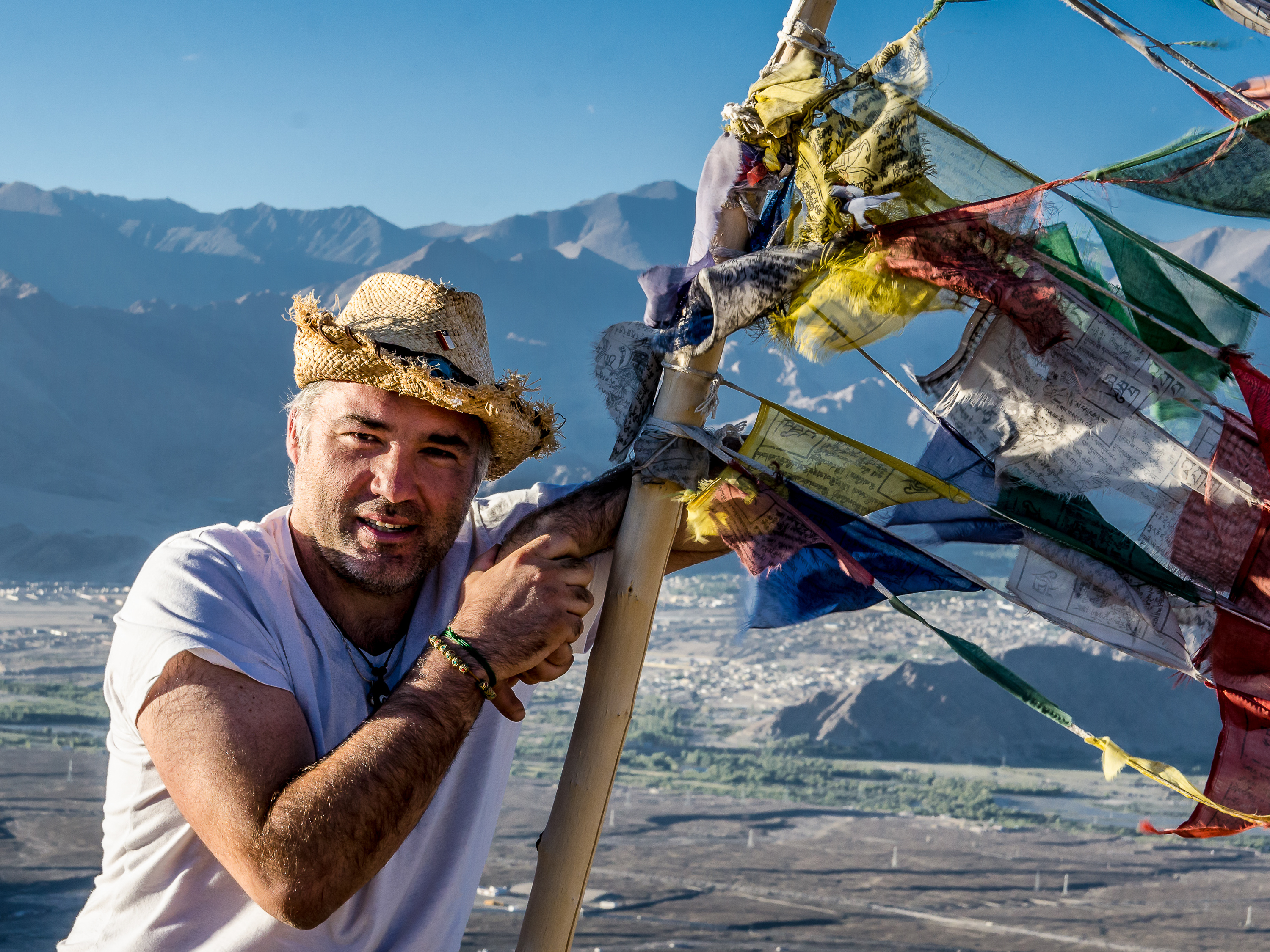
From Pola de Allande to Berducedo — Camino Primitivo

There are days on the Camino when you wake up knowing that the distance itself will not be the greatest challenge, because eighteen kilometres can hardly sound frightening after several days of walking, yet you also know that numbers can be wonderfully deceptive when those eighteen kilometres begin with a climb towards one of the highest points of the entire route.
Leaving Pola de Allande that morning, we had a relatively short stage ahead of us, the weather was beautiful, and after a good night's sleep and the rather excessive dinner we had enjoyed the previous evening, there was every reason to believe that the day would be straightforward.
It was not.
The first part of the route took us gradually out of Pola de Allande and into the valley, where the houses became increasingly scattered and the sounds of the town disappeared behind us. Asturias has a particular way of making its villages feel as though they have grown directly out of the landscape, with stone houses, slate roofs, small farms and old walls appearing naturally among the green hills rather than standing apart from them, and as we climbed higher, those signs of ordinary human life became fewer and farther between.

The road followed the valley of the River Nisón before beginning the long ascent towards Puerto del Palo, and at first the climb was gentle enough to create the dangerous illusion that the difficult part might not be so difficult after all. The path passed through meadows and woodland, occasionally revealing old stone houses and fields where animals were grazing, while somewhere below us the stream continued its journey through the valley, almost hidden beneath the trees.
There is a particular kind of peace that comes with walking uphill through such a landscape, because the physical effort gradually removes everything that is unnecessary from your thoughts. You stop worrying about emails, messages, appointments and all the small responsibilities that normally seem so important, and your attention becomes concentrated on remarkably simple things: where you are going to put your next foot, how much water remains in your bottle, how steep the path has become and whether the next bend will finally bring the climb to an end.
The Camino has a way of reducing life to its most basic ingredients, and perhaps that is one of the reasons why so many people become attached to it. You walk, you breathe, you eat, you drink, you rest and then you walk again.
Everything else becomes surprisingly unimportant.
As we continued upwards, however, the gentle beginning gradually disappeared and the mountain began to show us what it really had in store. The path became steeper, the steps became heavier and the distance between one comfortable moment and the next seemed to grow longer, until eventually I reached the point where I could feel the climb physically affecting me. I was tired, my stomach was beginning to turn, and the simple act of putting one foot in front of the other suddenly required considerably more concentration than it had earlier in the morning.

This was the stretch between approximately the fifth and eighth kilometres, where the route climbs towards Puerto del Palo at around 1,146 metres above sea level, making it the highest point of this stage.
At that point, the Camino stopped being a pleasant morning walk through Asturias and became a negotiation between the body and the mind.
How much further?
Can I keep going?
Should I stop?
Do I really need to reach the top?
These are not particularly complicated questions, but when your body is tired enough, they suddenly become surprisingly persuasive.
I have always found it interesting how quickly our perception of difficulty changes when we are exhausted. A hill that looked beautiful from a distance becomes an obstacle, a few hundred metres suddenly feel like several kilometres, and something that seemed completely manageable half an hour earlier can begin to look almost impossible. Yet the mountain does not actually change. What changes is the person walking up it.
Eventually, after the hardest part of the ascent, we reached Puerto del Palo, and with the effort behind us the landscape seemed to open almost as a reward. From up there, the mountains stretched away into the distance, the valleys lay far below us and the scale of the landscape made the climb feel somehow smaller than it had seemed while we were inside it.
There is something very satisfying about reaching the top of a mountain after you have genuinely questioned whether you want to continue climbing it, because the view is not simply a view anymore; it becomes part of the story of the effort required to reach it.

And then something rather wonderful happened.
At the summit, where we might have expected nothing more than an empty mountain road and the wind moving across the grass, there was a small mobile bar, and around it pilgrims were gathering.
Some had come from Pola de Allande, while others had taken the Hospitales route, the alternative mountain route that eventually meets the main Camino again in this area, and suddenly people who had spent the morning walking separate paths were standing together in the same place, drinking, talking, laughing and congratulating one another on having reached the summit.
It was one of those moments that captures something essential about the Camino, because nobody really cares where you come from when everyone has just climbed the same mountain. The businessman, the student, the retired traveller, the experienced pilgrim and the person walking their first Camino all become more or less equal when they are standing at the top of a difficult climb with tired legs and a bottle of water in their hands.
For a few minutes, the mountain had erased the differences between us.
We were simply pilgrims who had made it to the top.
There were horses wandering through the surrounding meadows as well, moving freely across the landscape with an almost complete indifference to the people celebrating nearby. They belonged to the mountains in a way that we never could, and watching them against the backdrop of the hills made the whole scene feel almost unreal, as though the Camino had temporarily created its own small world where humans, animals and landscape existed together without any need to explain themselves.
After the climb, however, there was still another lesson waiting for us, because reaching the highest point did not mean that the hard work was finished.

We now had to go down.
Descending a mountain after several hours of walking can be surprisingly unpleasant, particularly when the legs are already tired from the climb. The knees begin to complain, the feet take a different kind of punishment and the body has to control every step rather than simply pushing upwards, so although going downhill looks easier from a distance, it can sometimes demand just as much attention as the ascent.
The path wound through meadows and along the mountainside, revealing a new view with almost every bend, and far below us the road appeared and disappeared between the folds of the landscape. After the intensity of the climb, the descent offered a different kind of beauty, slower and more expansive, because there was now time to look around rather than constantly concentrating on the next difficult section of trail.
And then we saw Monte Furado.
The tiny village seemed to be hanging on the mountainside, surrounded by green hills and the vast landscape of Allande, with stone and slate houses that appeared almost untouched by the modern world. It was one of those places that seem to belong to another period of time, not because they have been artificially preserved as a tourist attraction, but because their remote position has allowed them to retain something of the character they must have had generations ago.
Monte Furado also carries an important part of the history of the Camino, because pilgrims have passed through this remote landscape for centuries, and the village once had a pilgrim hospital where travellers could find shelter while crossing these difficult mountains. The small chapel dedicated to Saint James, associated with that former hospital, remains one of the most evocative reminders of the area's connection with the pilgrimage tradition.

Standing there, it was difficult not to imagine the people who had travelled this same route hundreds of years before us, although their experience would have been almost unimaginable compared with ours. They did not have GPS showing their position, a weather application predicting the afternoon temperature, a mobile phone containing photographs of the route or, most importantly, a little mobile bar waiting for them at the summit after a difficult climb.
They had the path, the mountains, whatever food and water they had been able to carry, and the hope that somewhere beyond the next mountain there would be shelter.
In that sense, the Camino has changed enormously while remaining strangely unchanged.
The equipment is different, the roads are different, the villages are different and the people walking today come from every corner of the world, but the fundamental experience remains remarkably similar: you leave one place, you walk towards another, and for several hours you have no choice but to live inside the distance between the two.
Eventually, the descent continued towards Berducedo, and by that point the eighteen kilometres of the stage were beginning to feel considerably longer than they had looked on the map that morning. We were tired, the day had become very hot and the body was beginning to remind us that even a relatively short Camino stage can become demanding when most of its difficulty is concentrated into a few kilometres.
And somewhere between Monte Furado and Berducedo, my thoughts began to move away from the Camino itself and towards something that happens in ordinary life far more often than we probably admit: those moments when we become convinced that we have reached our limit.
We all know the feeling.
There are days when we genuinely believe that we have nothing left to give, when the problem in front of us seems too large, the distance too great and the amount of energy required simply more than we possess. Sometimes that feeling is telling us something important and the right thing really is to stop, rest and recover, because perseverance should never become an excuse for ignoring exhaustion, pain or the need to take care of ourselves.
But there are other moments when the feeling that we cannot continue is not quite the same thing as actually being unable to continue.
Sometimes there is still something left.
Perhaps it is only enough for one more step, followed by another step and then another, but we do not necessarily know how close we already are to the point where the road becomes easier.
That uncertainty is one of the strange things about difficult journeys, because when you are standing at the bottom of a mountain you can see how high it is, but when you are exhausted halfway up, you cannot always see how much remains.
You simply have to continue for a little longer.
And perhaps this is where perseverance becomes meaningful, because it is not really about proving to other people that we are strong. Nobody else is carrying our tired legs, nobody else feels the pain in our feet and nobody else knows how many times during the day we have privately asked ourselves whether continuing is really worth it.
The person walking beside us may encourage us, but ultimately the decision to take the next step belongs to us.

That is why I began to understand the idea of perseverance differently during this stage.
We do not necessarily need to be strong all the time, and we certainly do not need to demonstrate our strength to everyone around us. There is no prize waiting for the person who suffers the most, and there is no particular value in pretending that something is easy when it is not.
What matters is something much more personal: whether we can look at ourselves afterwards and know that we gave ourselves a genuine chance to continue.
The mountain does not care whether anyone is watching.
The Camino does not care whether we are impressive.
The landscape does not care whether we succeed.
The only person who really knows what the journey cost is the person who walked it.
And that is why reaching the end of a difficult stage can feel so much more satisfying than completing something that was easy from the beginning. The achievement is not necessarily the number of kilometres recorded on the watch or the altitude written on the map; it is the knowledge that there was a moment when you considered stopping and then decided to take another step.
Eventually, Berducedo appeared ahead of us, and with it came the quiet satisfaction of knowing that one of the toughest sections of the Camino Primitivo was now behind us. The village itself was small, but after a day in the mountains it felt welcoming, with a bar, a shop, restaurants and albergues where pilgrims were already relaxing, eating and talking about the day's journey.
The atmosphere was exactly what I had come to appreciate about the Camino: people who had been strangers that morning were now greeting one another as familiar faces, comparing experiences, discussing the weather and talking about the stages ahead. There were pilgrims from Japan, the United States, the Netherlands, Norway, Croatia, Spain and many other places, and despite the enormous differences between their lives outside the Camino, here they were all part of the same temporary community.
That evening, after the heat and effort of the day, the world seemed wonderfully uncomplicated.
You walk through beautiful countryside, you become tired, you find something to eat and drink, you meet people, you sleep somewhere new and then, the next morning, you begin again.
There is something almost luxurious about such simplicity, particularly when you have become accustomed to a life in which every day seems to demand attention from ten different directions at once. On the Camino, the outside world gradually becomes quieter, and for a while you are allowed to exist without constantly responding to it.
That is why the people you meet on the Camino become such an important part of the experience, because when everyone is temporarily removed from their ordinary lives, there is very little need to pretend to be anything other than who you are.
Our accommodation that night was Casa Aracheli, a traditional stone house dating back to around 1600 that has been renovated while retaining much of its original character, and after the long climb, the steep descent, the heat and the endless mountain paths, being welcomed into such a place felt like a small reward in itself.

When I look back at that day now, I do not remember it simply as the stage between Pola de Allande and Berducedo, nor do I remember it only as the day when we climbed to Puerto del Palo and descended towards Monte Furado.
I remember it as the day when a mountain forced me to reconsider what it means to keep going.
There is an important difference between endurance and stubbornness, between listening to your body and giving up simply because something has become uncomfortable, and perhaps the Camino teaches us to recognise that difference more clearly because there is nowhere to hide from the physical reality of the journey.
Sometimes you really do need to stop.
Sometimes you need to rest.
And sometimes, when you are convinced that you have nothing left, there is still one more step inside you.
The difficult part is that you usually cannot know which situation you are in until you ask yourself honestly.
So the real question is not whether we are strong enough to finish the entire journey, because that question can feel impossibly large when we are standing at the bottom of a mountain.
Can I take one more step?
And if the answer is yes, then take it.
That, more than anything, may be what perseverance really means.
Not proving to the world that you can do it, but quietly discovering for yourself that you could.
And somewhere ahead of us, the Camino was already preparing the next lesson.
See you next time,
Vashek

Stage: Pola de Allande → Berducedo
Distance: 17.4 km
Difficulty: Short but intense, mainly because of the long initial ascent
Highest point: Alto del Palo, approximately 1,146 m
Main ascent: Around 600 m over the first 8 km
Surface: Predominantly dirt and gravel tracks, with less than 3 km on asphalt or concrete
Main places: Pola de Allande → El Mazo → Montefurado → Lago → Berducedo
Important landmarks: Alto del Palo, Montefurado, Montefurado Chapel, Lago and Berducedo
Historical character: Medieval pilgrim hospitals once provided assistance along this demanding section, including hospitals at Montefurado, Lago and Berducedo.
PS: At the end of the series I will publish a guide book with all camino information :) Stay tune.
Ps: If you enjoy the reading and would like to support me, you can buy me a coffee :)

English video on Youtube: (thank you of you subscribe to get notified) New episode every Sunday at 5:00 PM CET

Comments