
Day 8. Camino Primitivo | Wen does the crisis hit?
From Padron to O Cádavo Baleira | Camino Primitivo | When does the crisis hit?

There is a moment on the Camino when the landscape begins to feel different, even though there is no obvious border to cross and no single landmark that tells you that something has changed. The mountains are still there, the road continues through forests and open countryside, and the yellow arrows still point towards Santiago, yet somewhere along the way the character of the journey begins to shift. On the eighth stage, from Fonsagrada to O Cádavo Baleira, the Camino Primitivo continues deeper into Galicia, and with every kilometre the feeling of having entered a new part of the journey becomes stronger.
After the long previous day from Grandas de Salime, across Alto del Acebo and into Fonsagrada, this stage begins with a different kind of awareness. The body already knows the rhythm of the Camino, the feet understand what another day of walking means, and the mind no longer needs to ask whether it is possible to keep going. The question has quietly changed from Can I do this? to something much simpler: Where does the road take me today?
Fonsagrada is a fitting place to begin such a day. The town has been connected with the pilgrimage route for centuries, and its name is traditionally associated with the Latin Fontem Sagrada, the sacred spring that became an important reference point for pilgrims. From here, the Camino continues through the interior of Lugo province, following a landscape that feels remote, green and deeply rural, with small settlements appearing between stretches of forest and open farmland.

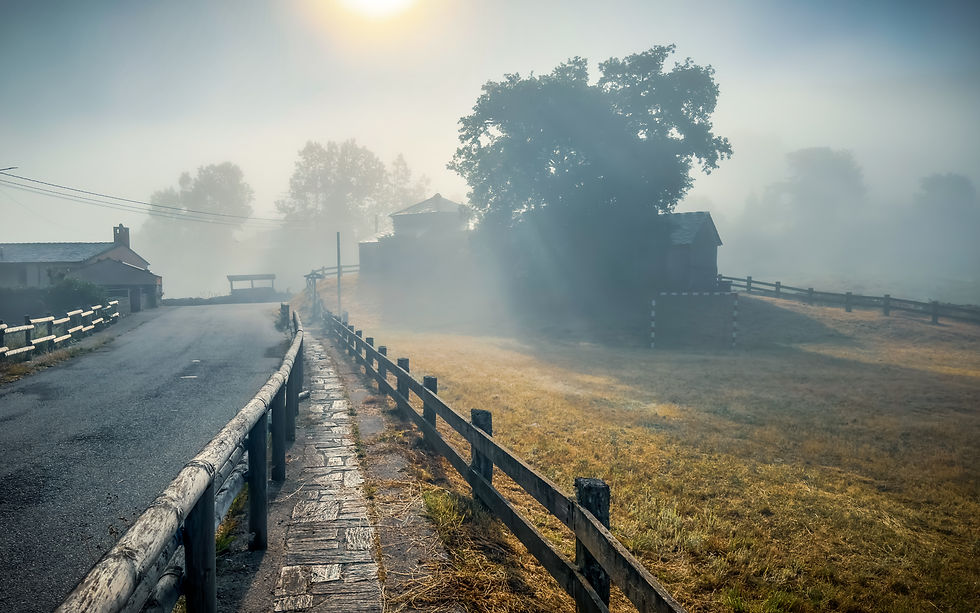
The morning began early, around half past six, with the remaining flashes of a distant thunderstorm illuminating the sky behind us. Anticipating the afternoon heat, which was projected to reach an oppressive thirty-three degrees Celsius, we set off early to cover the upcoming twenty-four-kilometer journey. Departing from the charming Casa de Lebranza, we bypassed an early morning coffee, a decision that would quickly turn into a source of bitter regret as the hours wore on without a caffeine fix.
The trail immediately introduced an upward slope as we climbed past the village of Villardedongo. Surprisingly, the ascent felt far more manageable than expected, perhaps signaling that our legs were finally adapting to the relentless demands of the mountains. Along the way, encounters with local horses and vintage tractors provided a pleasant distraction, prompting a brief pause to capture a few photographs. At the summit, we stopped for breakfast at a broken wooden table, where a magnificent panorama unfolded before us. It was a bittersweet moment, marked by the realization that such sweeping mountain views would become increasingly rare as the trail drew closer to Santiago de Compostela.

Continuing up the trail, we reached the dramatic high point of the stage at the historic Hospital de Montouto. Perched at an elevation of over 1,050 meters above sea level in the Sierra del Hospital, this site carries a profound sense of history. Originally founded in 1357 by Order of King Pedro I "The Cruel" (and later renovated in 1698), Montouto served as the most vital pilgrim refuge in the Galician mountains for over five centuries, operating continuously until the early 20th century. Surrounded by sweeping vistas and prehistoric megalithic dolmens, the stone ruins—along with a nearby 17th-century chapel dedicated to St. James—stand as a stark reminder of how treacherous these high-altitude passes were during harsh winter blizzards. Standing among the ancient remnants offered a moment of reflection on how little the essence of the journey has changed, even if modern hiking gear and GPS tracking have replaced the simple staves and cloaks of medieval pilgrims.

Leaving the windswept ruins behind, the route began a steady descent along quiet slate tracks bordered by thick heather and pine woods. Relief arrived at the 10.5 kilometer mark in the form of a rustic tavern. The simple luxury of a cold drink and a warm cup of coffee felt like a true lifesaver, reviving both body and mind. The stop provided a welcome opportunity to reconnect with familiar faces from previous stages, exchanging stories about local football, comparing minor injuries and blisters, and sharing a few laughs over lighthearted trail mishaps. These casual interactions highlight one of the most rewarding aspects of the Camino, where strangers meet without pretense or judgment, forming genuine connections through shared experiences.
The second half of the stage proved to be a grueling test of endurance, featuring two steep climbs that pushed us to our limits in the rising heat. Reaching the seventeen-kilometer point brought us across another exposed ridge before beginning the final approach.
What lay ahead was what felt like a literal Highway to Hell—a long, agonizing stretch of asphalt baking directly under the relentless midday sun. With zero shade, no breeze, and the heat radiating off the road surface, every single step felt like a triumph of pure willpower over total exhaustion. At one point, a small shaded picnic spot offered a brief sanctuary, allowing us to rest alongside several other weary, heat-drained pilgrims before steeling ourselves for the final push into town.

Reaching our destination brought an overwhelming sense of accomplishment. After covering twenty-four taxing kilometers and enduring temperatures that made the final asphalt stretch feel like an oven, we checked into a modest local pension located right near the town center. With essential services like a pharmacy, bank, and ATM nearby, the small Galician town offered everything needed to recover from a long day on the trail.
The afternoon ended in the best possible way: with a cold beer, a hot shower, and a chance to sit back and rest tired legs, fully appreciating the simple satisfaction of another completed stage on the Camino Primitivo.
The road towards Santiago continues.
See you next time
Vashek

TThe route at a glance
Stage: Fonsagrada → O Cádavo Baleira
Distance: Approximately 24 km
Region: Galicia, Lugo province
Difficulty: Moderate to demanding, depending on weather, terrain and accumulated fatigue from previous stages
Landscape: Forests, agricultural countryside, rural roads, meadows and small Galician settlements
Main character: A quiet inland stage through rural Galicia, with long stretches of peaceful walking
Destination: O Cádavo Baleira
Camino character: A stage where the physical rhythm of walking begins to become a natural part of everyday life on the Camino Primitivo
PS: At the end of the series I will publish a guide book with all camino information :) Stay tune.
Ps: If you enjoy the reading and would like to support me, you can buy me a coffee :)

English video on Youtube: (thank you of you subscribe to get notified) New episode every Sunday at 5:00 PM CET


Comments